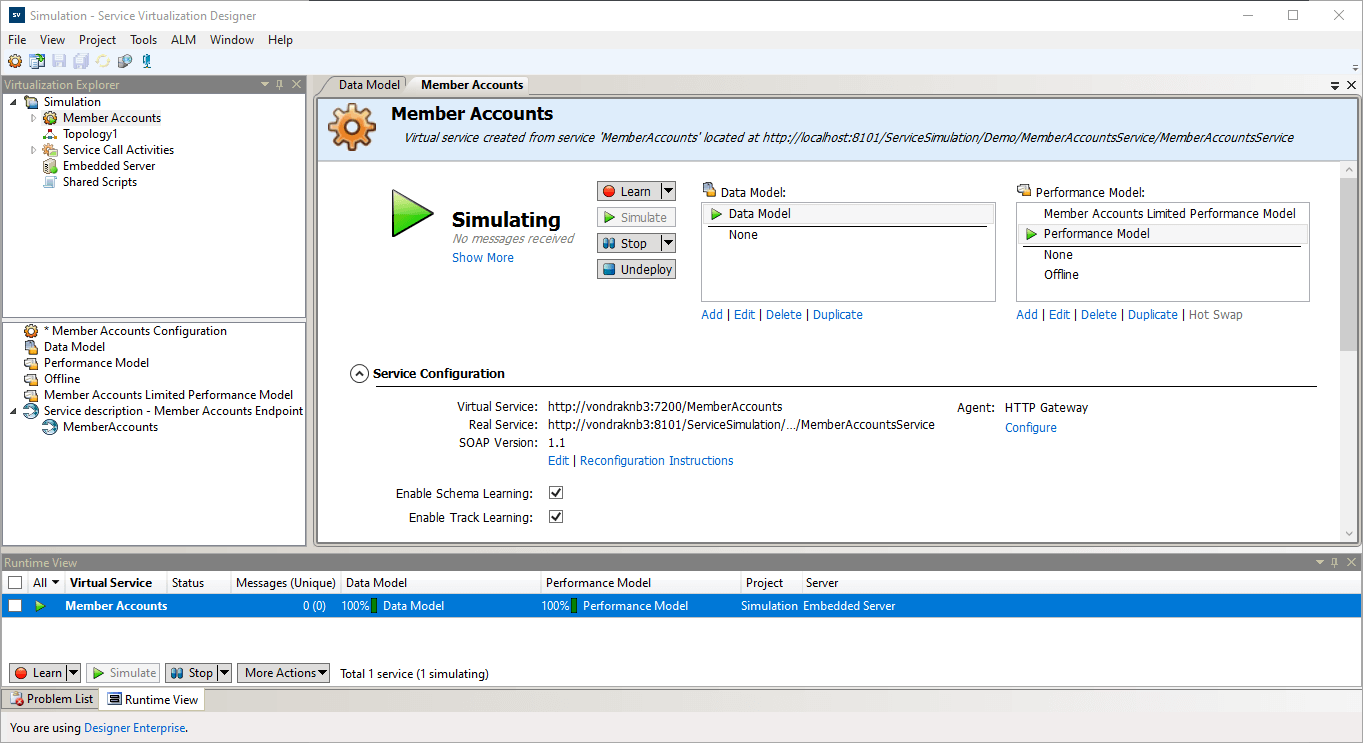
Service Virtualization software removes the development and testing “wait time” that can slow delivery of applications. It enables your teams to easily create realistic simulations of service behavior—so you can stay on schedule even when dependent application components or systems aren’t available. Simply put, you can focus on service quality rather than resource constraints.
Suggested for you are based on app category, product compatibility, popularity, rating and newness. Some apps may not show based on entitlements. Learn more about entitlements.
Agent and Technology Updates
Kafka support is introduced as a new BETA capability, integrated across both SV Designer and SV Server.
You can design and run Kafka-based virtual services, giving teams an early way to virtualize Kafka integrations in modern, event-driven environments.
Architecture Update
The embedded server architecture has been decoupled, and the embedded runtime now uses a standalone server model.
This change enables .NET 6 support and improves compatibility with modern runtime and deployment environments, reducing the differences between local embedded usage and server-based deployments.
Security and Infrastructure
Security
Bug fixes and Usability
Licensing Enhancements
Security and Infrastructure
Upgrades to third‑party libraries to address security vulnerabilities and remediation of identified code vulnerabilities.
Agent and Technology Updates
New REST API Endpoints
Two new API endpoints have been introduced to improve monitoring and automation:
Service Virtualization 25.3 is the re-launch under the OpenText brand, cadence, and standards.
Service Virtualization offers some of the most extensive support for protocol coverage for services and API testing in the industry and Service Virtualization 25.3 delivers on that platform. This version includes many security enhancements, improvements in performance and stability, enhancements to how service calls are managed along with improved alert capabilities. New port configuration options along with improved virtual service details such as new metrics and runtime details yield an improved user experience.
The Service Virtualization 2023 R1 release focuses on stabilization, bug fixes, and usability improvements. The main new enhancements include new self-paced online training, enhanced C# scripting, improved debugging, easier data driving, updates to protocol hooks and existing protocols, new type of functional virtual service, and improved security and infrastructure.
SV Lab is an environment virtualization toolkit that complements Service Virtualization in areas that would be otherwise difficult to handle using virtual services based on the standard data model. This version fixes several security vulnerabilities.
Please upgrade to one of the following broswers: Internet Explorer 11 (or greater) or the latest version of Chrome or Firefox